





How we identified four value bets the market missed — and why it was no accident
Welcome to our Six Nations 2026: Rugby4Cast Value Deep Dive. The Six Nations 2026 is over, France are champions, and our model finished the tournament with four winning value calls from five identified opportunities. This piece is not the weekly review. You can read that here: https://sports4cast.com/six-nations-2026-final-review-2026/ but this is something different. We found that this Six Nations presents a particularly useful case study in how we go about making our picks and why they are successful, and it deserves a closer examination.
As The Smart Betting Club independently verified recently, our picks are generating a 10% return over the year across all our recommendations. That is not a number we have calculated ourselves or presented without scrutiny. They are one of the most respected independent auditing bodies in the sports betting industry, so this is excellent news if you are already a subscriber, and a great incentive to get on board if not. Anyway, the Six Nations provides an excellent window into how we go about making our picks and why, and how following them pays off for our subscribers.
Four from five winning value bets with average odds of 3.56 on our four winning picks. We repeatedly predicted where the market was misvaluing matches.
The Framework: How We Find Value
Before we get into the individual picks, it’s worth explaining what we mean by “value.” A value bet isn’t simply a bet we think will win. It’s a bet where we believe the true probability of an outcome is meaningfully higher than what the bookmakers’ odds imply. For those like me who dozed through GCSE Maths and are regretting it now, it basically means: we think a team is going to win more than the bookies do.
Our model generates win probabilities for every match using a combination of historical performance data, current form metrics, home advantage adjustments, and squad-level indicators. This model gives us a probability of victory for each side and then we compare that number to the implied probability baked into the market odds.
If the bookmakers price a team at 25% (odds of 4.00 or 4/1) it means they give them a one in four chance of winning. If our model puts their true probability at 40%, that’s a significant edge. It’s not a guarantee of winning as any given match can go either way (and the beauty of sport), but over a sufficient number of such bets, positive expected value adds up. This tournament was a strong proof of concept.
An incorrect strategy would simply be, who do I think is going to win, OK, I will bet on that team. There is risk involved in betting. Significant risk, and so to bet without knowing whether the bookies are giving you odds which correspond to the risk involved is crazy. And also why you should instead look for value, discrepancies, rather than simply who you think will win a given match.
Nearly all of our value picks were on teams the market considered underdogs. We were not chasing favourites, we were correcting what we believed were systematic mispricing events.
Now let’s look at each pick in detail.
The Five Picks at a Glance
| Match | Our Pick | Odds | Mkt Prob. | Our Prob. | Result |
|---|---|---|---|---|---|
| France v Ireland (Rd 1) | Ireland | 3.24 | 31% | ~45% | ❌ Loss |
| Scotland v England (Rd 2) | Scotland | 4.00 | 25% | ~40% | ✅ Win |
| Ireland v England (Rd 3) | Ireland | 5.00 | 20% | ~42% | ✅ Win |
| Scotland v France (Rd 4) | Scotland | 4.50 | 22% | ~38% | ✅ Win |
| Ireland v Scotland (Rd 5) | Ireland | 1.50 | 67% | ~78% | ✅ Win |
Pick 1 — France v Ireland (Round 1)
The Call: Ireland @ 3.24 | Result: LOSS
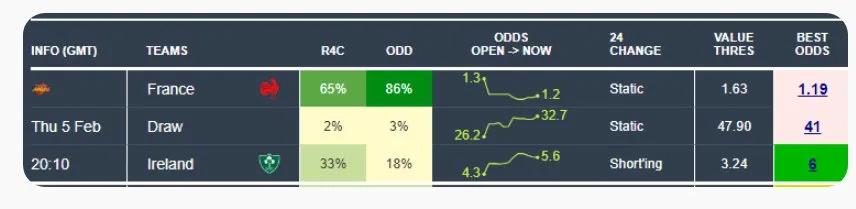
France opened the tournament as overwhelming favourites at home, with the market pricing them at approximately 86% probability of beating Ireland, which was probably a reflection of their world ranking, strong recent form and the considerable advantage of playing at home. Our model had them as favourites too, but not by that margin. We put Ireland’s true win probability closer to 45%, which made the 3.24 available on Ireland a genuine value opportunity.
The reasoning was grounded in two things: Ireland’s historical ability to perform in Paris, and what we read as an overreaction by the market to France’s autumn internationals form. The narrative heading into the Six Nations was that this Irish team was past it. Narrative such as this, even if it has a kernel of truth, is excellent for creating value in the market. Punters pile in as it becomes common knowledge that “this isn’t the Irish team of old”, and so the odds lengthen in our favour. This happens all the time in sport. Bookmakers have to respond to what punters are doing, reducing odds on a team that is attracting heavy money in order to cover themselves in the event that they win. A narrative emerges, punters pile in, and the true probabilities become obscured. Perfect territory for a dispassionate algorithm to do its work.
In this case, there may well have been some truth in the Irish “past it” narrative, but the model suggested that their losses in the autumn were not as bad as people had made them out to be and that they were closer to the other main northern hemisphere rivals than the market was pricing.
Having said all that, it did not come off. Betting is risky, and Ireland simply did not show up. France were imperious in the first half and the result was settled long before full time. It is important to note that we were not saying Ireland were going to win. We thought France were more likely to win, so whilst we were wrong in one sense, we were quite right in another. The logic was sound, the odds were incorrect, and we would make the same call again with the same information.
Key lesson: Value identification is a process, not a guarantee. The edge lies in the long run, not necessarily in a single match.
Pick 2 — Scotland v England (Round 2)
The Call: Scotland @ 4.00 | Result: WIN

This was a call that on the surface did not look like a great idea. England arrived in Edinburgh on the back of eleven consecutive wins, generating considerable media momentum and bookmaker confidence. Scotland were also coming off a terrible loss away to Italy where all the good vibes and momentum they might have carried from the autumn had gone up in smoke. England were priced around 77% to win at Murrayfield, leaving Scotland available at 4.00.
Our model told a different story. Several factors converged to make Scotland underpriced. The most significant was Murrayfield itself. Scotland’s home advantage in this fixture is historically significant and chronically underweighted by markets that focus too heavily on recent form. Scotland had an excellent recent record against England, and a particularly strong one when considering only matches played at Murrayfield. England had done very well to close the gap on the top teams during the autumn and it looked as though they had broken onto the top table. However, we still considered Scotland’s historical performances against England to carry greater weight than the bookmakers evidently did.
In the end, this was a great pick. Scotland won comfortably, the Murrayfield factor proved decisive, and England were far from the team they had been in the autumn. They would go on to have a miserable Six Nations.
The Murrayfield effect was undervalued by betting markets, as were historical matchups. This is an element which the bookies consistently underplay.
Pick 3 — Ireland v England (Round 3)
The Call: Ireland @ 5.00 | Result: WIN
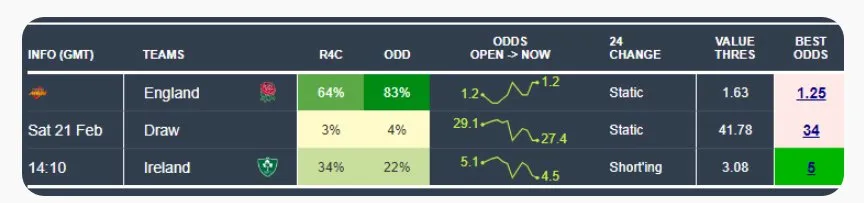
Fresh off a beating against Scotland, our next pick was backing Ireland at “HQ”. Ireland were priced at 5.00, meaning that the market was giving them just a 20% chance of beating England. Despite the opening day humbling by France, which had corrected their value a little, Ireland were still being consistently undervalued by the bookmakers, possibly because the France game had appeared to confirm the previous narrative about this Irish team being in decline.
Additionally, the market had not fully adjusted to England’s defeat in Scotland. There appeared to be a lag in sentiment, with punters treating Murrayfield as a one off rather than a sign of things to come, and focus remained on the eleven game unbeaten run rather than on what Scotland had revealed about England’s structural limitations.
Our model placed Ireland’s true probability at approximately 42%. We did not think Ireland were clear favourites. We thought the match was roughly a coin flip with home advantage, which made 5.00 extraordinary value and, in our view, the best opportunity of the entire tournament.
Ireland won convincingly. The problems England had first shown in Edinburgh were amplified by Ireland at the Aviva, and the model’s read on the match was validated entirely.
This was our best pick of the tournament on a value basis — the gap between market price and our model’s probability was the widest of the five.
Pick 4 — Scotland v France (Round 4)
The Call: Scotland @ 4.50 | Result: WIN

By the time Scotland hosted France, both teams were back on track. In our big preview prior to the tournament we had identified the role Scotland would play in affecting the title chances of the favourites, namely France, Ireland and England. England and France had to travel to Murrayfield which, as we had already seen in England’s case, was enough to knock them out of contention. Ireland had Scotland at home, which was a significant advantage, and on that basis we had considered Ireland possible favourites even accounting for their opening defeat in Paris. Simply put, we had spotted from over a month out that Murrayfield was going to be a tough test for this French team.
The market was still not pricing it correctly. France were genuine title contenders and had looked excellent in bursts throughout the tournament, and the market priced them at around 78% to win in Edinburgh. In a two horse race, that is an extraordinarily strong vote of confidence in one side, particularly away from home and up against a quality outfit.
Our model had France as favourites, and quite strong ones, but at a far more realistic 63%, giving Scotland a 35% chance of winning. Put simply, if that match were played three times, Scotland would win one of them, and at 4.50 that represented excellent value.
What followed was therefore actually quite predictable to those who had done the analysis. Scotland were brilliant on the day and put France to the sword, with France also scoring freely enough to pass 40 points in a remarkable match. Scotland were simply too good, and it was the second Murrayfield upset of the tournament and the second time the market had underpriced it.
Pick 5 — Ireland v Scotland (Round 5)
The Call: Ireland @ 1.50 | Result: WIN

This was the most conservative of our five picks. Scotland had got all the glory from beating France, and talk was of them finally winning the Six Nations for the first time if they could beat Ireland in Dublin and England could get a result against France in Paris. Ireland, remarkably, were still under the radar. It takes a lot for journalists to admit they were wrong, and as such narratives often linger even after reality has shown them up to be false. Ireland in Dublin against Scotland were bankers as far as the model was concerned. Scotland were historically hopeless in Dublin, both sides had improved considerably since the opening weekend, and Ireland were the better team by a considerable distance according to our numbers, which gave them a 79% chance of victory.
The market was backing Ireland, but only at 66%, a 13 percentage point difference which represented excellent value. To put it another way, any odds of 1.32 and above were good value on Ireland, and the available price of 1.50 was therefore a comfortable pick.
In practice Ireland won by a large margin, though France still took the title on bonus points. Our final pick of the tournament was also our fourth winning pick and, although the odds were modest, the value relative to the true probability was as clear as anything else we identified across the six weeks of the competition.
What It Would Have Made You
So now we have looked at all the picks, let’s look at what the return on your investment would have been:
| Bet | Stake | Odds | Return | Profit/Loss |
|---|---|---|---|---|
| Ireland v France (Loss) | £10 | 3.24 | £0 | -£10 |
| Scotland v England (Win) | £10 | 4.00 | £40 | +£30 |
| Ireland v England (Win) | £10 | 5.00 | £50 | +£40 |
| Scotland v France (Win) | £10 | 4.50 | £45 | +£35 |
| Ireland v Scotland (Win) | £10 | 1.50 | £15 | +£5 |
| Total | £50 | £150 | +£100 |
£50 staked. £150 back. 200% ROI across the tournament.
That’s the flat-stake number — the same amount on every pick regardless of confidence level. In practice, our premium model assigned different confidence levels to each pick. Ireland v England at 5.00 was flagged as the highest-value bet of the tournament — the widest gap between our probability and the market’s. A sensible staking approach weighted to confidence would have returned considerably more, given that pick alone returned 5x the stake.
The one loss cost £10. The four wins returned £150. That asymmetry is exactly what value betting is designed to produce: losses are capped at your stake, wins at high odds are multiples of it.
What This Tournament Tells Us
Four wins from five value picks across a major international tournament is a result we are pleased with, but the headline number is not really the point. The point is what it demonstrates about how successful betting actually works, and it has very little to do with backing the most likely to win a rugby match.
What our model does is identify value. It asks not who will win, but whether the price available on any given outcome accurately reflects the true probability of that outcome occurring. Those are very different questions, and the distinction matters enormously. A bettor who simply backs the team they think will win is playing a different and considerably riskier game than one who is asking whether the odds on offer represent fair value. The Six Nations this year illustrated that beautifully. We did not back Ireland at Twickenham because we thought they would beat England. We backed them because the price implied a 22% chance of winning and we believed their true probability was closer to 34%. That is where the edge lies, and that is what our model is built to find.
Any bettor, whether they follow our picks or not, should be asking the same question before placing any bet. Are the odds I am being offered an accurate reflection of what is likely to happen, or am I being short-changed by a market that has been distorted by public sentiment, lazy narrative, or slow adjustment to information, or simply, taking advantage of people like you? If you cannot answer that question with some confidence, you are not betting, you are guessing, and the bookmakers are very happy for you to keep doing so. Our tools are there to help you avoid making poor bets which do not make mathematical sense.
It is also worth being completely clear about risk, because no honest discussion of betting can avoid it. Sport is wonderful precisely because upsets happen. Quite conceivably, every single one of the picks we have discussed in this piece could have lost. Scotland could have been beaten at Murrayfield twice. Ireland could have been beaten in Dublin. Value identified in a bet is not a guarantee that it it will come in. Even with an accurate model and a verified 10% return over the year, there will be losing runs, there will be tournaments that do not go to plan, and there will be individual bets that look excellent on paper and lose anyway. That is sport, and it is not going to change.
What a disciplined bettor with access to accurate modelling can do is avoid throwing their money away on bets where the value simply is not there, identify the genuine opportunities when they arise, and trust the process over a long enough time for the results to emerge. The 2026 Six Nations was a very good example of what that looks like in practice.